Rebuilding the contextual targeting system
Two weeks in, I rescoped the project...
I joined the contextual targeting team to ship what was framed as a straightforward feature: add boolean logic (AND/OR) to how advertisers combine targeting segments. Existing patterns from a parallel audience-targeting effort made it seem like this would be a quick fix.
After several weeks of stakeholder conversations and some foundational user research session, I uncovered the root of the problem at hand. The real gap was that advertisers had no sustainable way to build, reuse, or understand contextual strategies on the platform. Simply adding the "boolean logic" functionality would be applying a band-aid fix to a much larger problem.
This case study walks through how I got there, what I designed instead, and what shipped.
Project outcomes
Surpassed $50M total spend target in Contextual Targeting by the end of 2025 by $5M
Reduced contextual strategy setup time by 40% with the creation of reusable strategies
↑ 50%+ in Contextual Strategies applied
Cross-team adoption of building block hierarchy solution
Successfully led design across 1 PM, 7 engineers, 2 UX partners (content and research)
The Trade Desk is a demand-side platform that allows advertisers like Coca-Cola and Walmart to purchase digital ad inventory across display, video, audio, CTV, and native channels.
Contextual targeting is one of many ways advertisers decide where their ads should and shouldn't run (e.g., "show ads on outdoor travel pages" / "block ads near terrorism content"). It's a growing strategic priority for the industry as third-party identifiers get deprecated.
 The Trade Desk's Kokai, launched in 2023
The Contextual Marketplace structure
The marketplace consists of various data providers, including our own in-house TTD data, which offers segments of classified content by topic, brand safety, or sentiment, that advertisers can choose from to target or block within their ad campaigns or ad groups.
Data providers
Companies that analyze web content, classifying pages into segments based on topic ("Sports" or "Finance"), brand safety levels ("Low Risk for Violence"), or sentiment.
Advertisers
Select segments from data providers to target or block in their campaigns and ad groups.
The inherited problem space
When I joined, the team had identified four issues with how the contextual marketplace worked:
Issue 1
Overlapping segments across data providers.
Issue 2
Advertisers are charged in full per provider, regardless whether 1 or 10 segments were chosen.
Provider A
Provider B
Desk
The inherited problem space continued...
Issue 3
Inability to add dynamic targeting logic → narrow reach.
Issue 4
Tens of millions in revenue opportunity unrealized as TTD tripled the number of contextual data providers in 2024.
The proposed solution
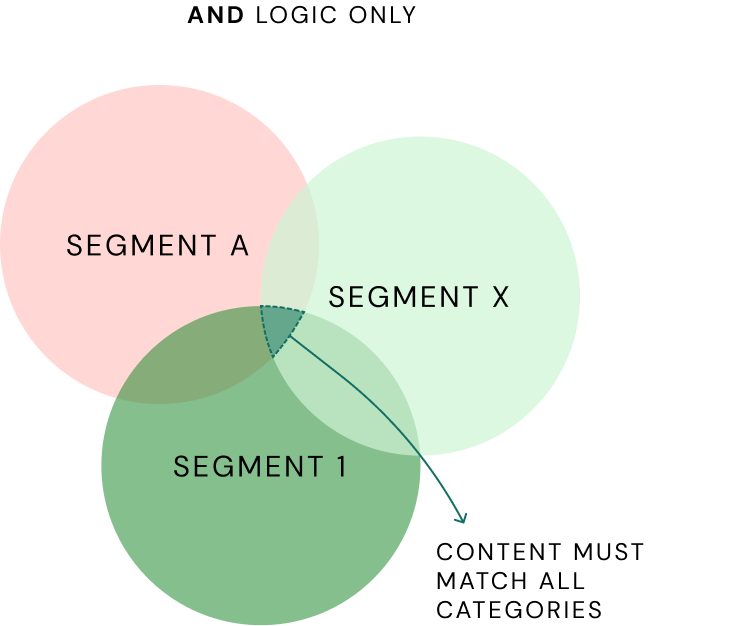
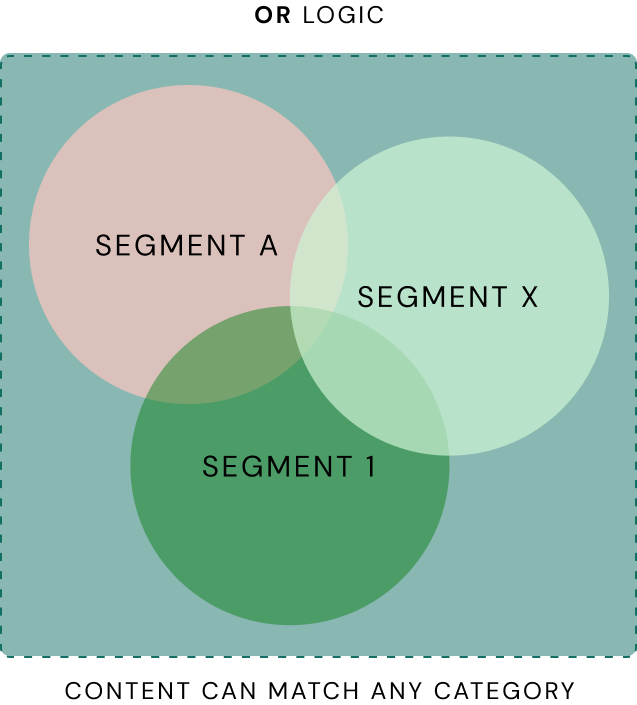
The solution asked of me was to incorporate this dynamic targeting logic, where advertisers would apply both AND and OR logic to the segments they wanted to target and/or block in their contextual strategies.
Why I pushed back
Starting with stakeholder conversations across PM, the backend data team, and the parallel audience-targeting effort, I started to rethink the initial brief. My discussion with engineering immediately highlighted that our data model only supported a single-use targeting flow. Adding AND/OR logic would technically work, but every campaign would have to rebuild the same logic from scratch.
Foundational UXR with seven advertisers confirmed this. Three patterns became evident at the end of our sessions:
Advertisers were cloning campaigns to avoid rebuilding strategies and copy their targeting setup.
This was fragile and error-prone. One trader described maintaining a personal spreadsheet to track which campaigns used which segment combinations.
Strategies needed to live above the campaign.
Advertisers thought in terms of brand-safe contexts (e.g., "our automotive evergreen strategy"), not individual campaign setups. The platform forced them to recreate the same strategy per ad group, with no way to update centrally when a data provider changed.
Pricing and overlap were opaque.
Advertisers couldn't see when segments from different providers covered the same content, and they were charged per provider regardless of how many segments they used. Without transparency, they couldn't make informed tradeoffs, so they defaulted to whichever provider their account team mentioned first.
Boolean logic alone wouldn't resolve these concerns. We needed a way to make strategies reusable, manageable, and transparent, with boolean logic as one capability within them. I socialized this concept with my PM and engineering leads, including a working session with the data team to confirm feasibility and accuracy and ultimately, obtained alignment to expand the scope.
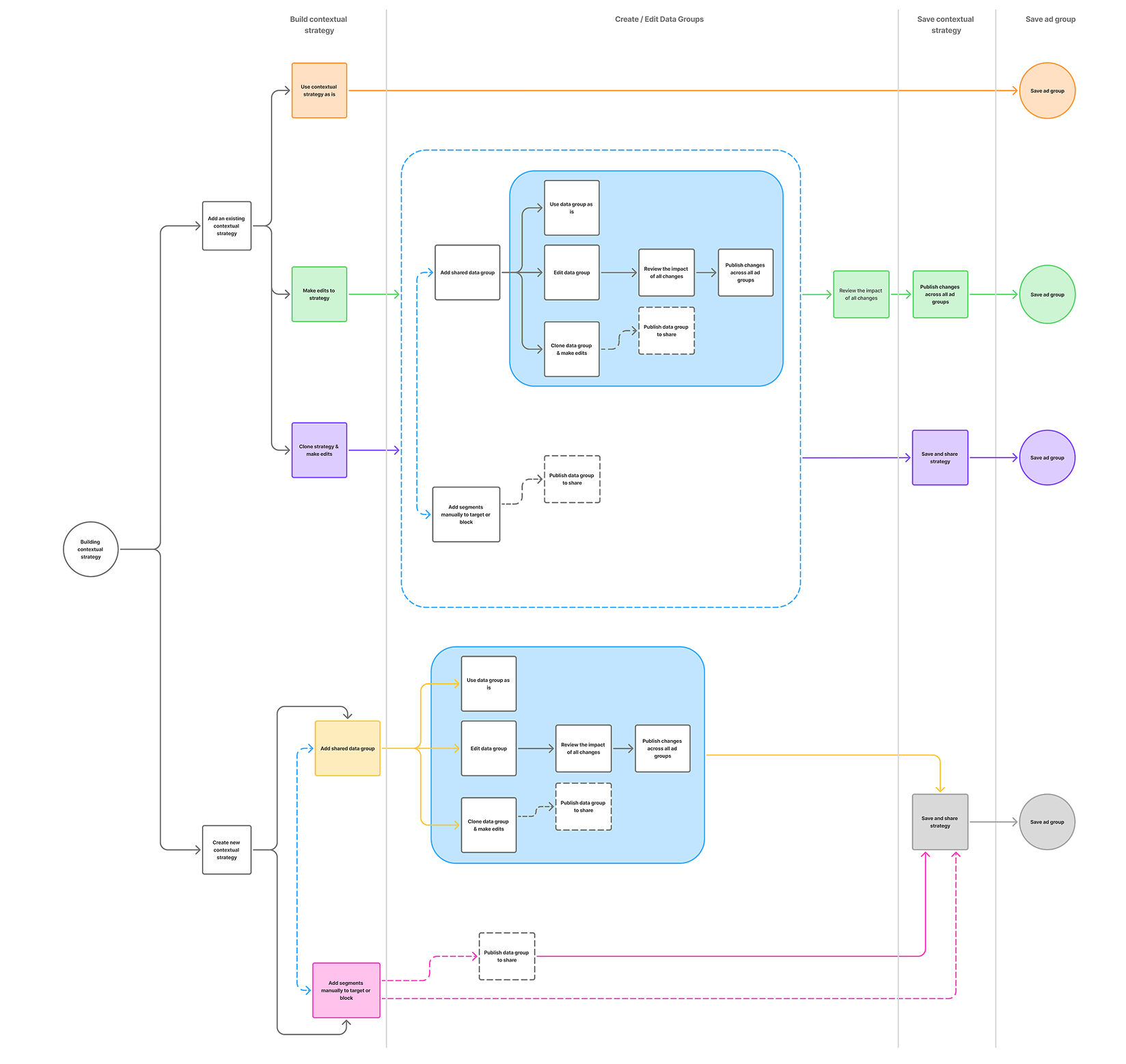 A flowchart I created to brainstorm the reframed problem
Contextual building blocks
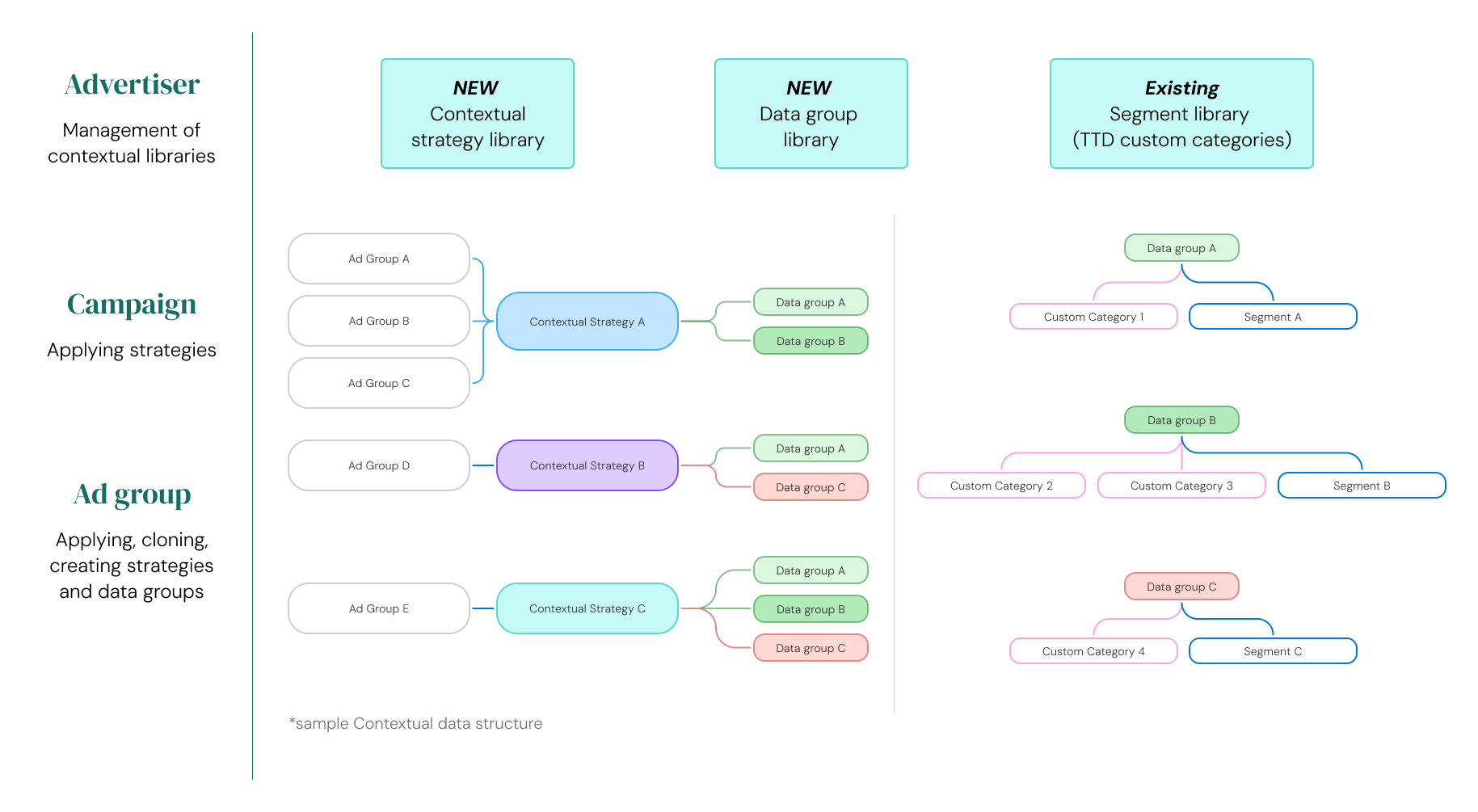
Working with my PM, engineering lead, and content writer, I defined three objects and the relationships between them.

Segment ≈ custom category
Categories of URLs, app IDs, content signals, etc. by topic from 3rd party contextual data partners & in-house offerings

Data group
Group of segments that are targeted or blocked within a contextual strategy.
Data groups can be reused if they're saved and managed in the saved data group library at the advertiser-level.

Contextual strategy
Collection of targeted and/or blocked data groups combined into one strategy.
Contextual strategies can be reused and managed in the contextual strategy library at the advertiser-level.
The alignment on these building blocks required broader horizontal alignment across other product teams, like retail and data measurement, to ensure we were using this naming structure consistently from a hierarchy standpoint. I led working sessions with design and PM counterparts to compare the objects we were working with and agree on shared principles. This naming structure became a shared pattern that other teams have adopted.
How these building blocks fit in the campaign hierarchy
Each ad group connects to a single contextual strategy. A strategy contains targeted and blocked data groups. Data groups contain segments. We shipped this as an upgrade path so existing campaigns kept working with no disruption to active spend.
Applying the building blocks to the design
Contextual strategy creation @ the ad group level
This flow walks through an advertiser creating a new strategy from scratch within an ad group (most granular level). The building blocks are shown entirely in context to the ad group here and you'll see that users are encouraged to leverage existing objects from their respective libraries to simplify their workflows. It also demonstrates how an advertiser might save a data group they've just created for reuse later on, all within the context of their strategy creation.
Click to walk through the flow.
Applying and editing a saved strategy @ the ad group level
This flow walks through an advertiser adding an existing strategy from the library to their ad group. When strategies are added from the library, the badge next to the strategy name will callout how many ad groups currently have it in use. This is an important metric for advertisers to take note of when they want to make edits. Any edit to a shared strategy will impact the other ad groups also leveraging it. Because of this, a warning interstitial alerts is provided before users move to the editing modal.
Click to walk through the flow.
Editing a saved strategy @ the advertiser level
This flow walks through an advertiser making changes to an existing strategy from the Contextual Marketplace at the advertiser (highest) level. At this altitude, the advertiser can access all strategies, data groups, and custom categories saved within their domain.
Click to walk through the flow.
Problem definition is central to product work, regardless of how fast we’re shipping.
I ensure to allocate sufficient time when onboarding to any new project thinking about the problem we're solving from every angle to ensure it accurately reflects user needs. This extra time spent upfront is just small cost in comparison to the potential cost of shipping the wrong solution to the wrong problem.
Horizontal alignment is expensive upfront, but has the potential to build lasting positive impact.
It was challenging to pull our retail and data measurement teams out of the siloes we typically work in, but the relationships built in those working sessions have improved cross-team efforts and builds consistency for our users throughout the platform.